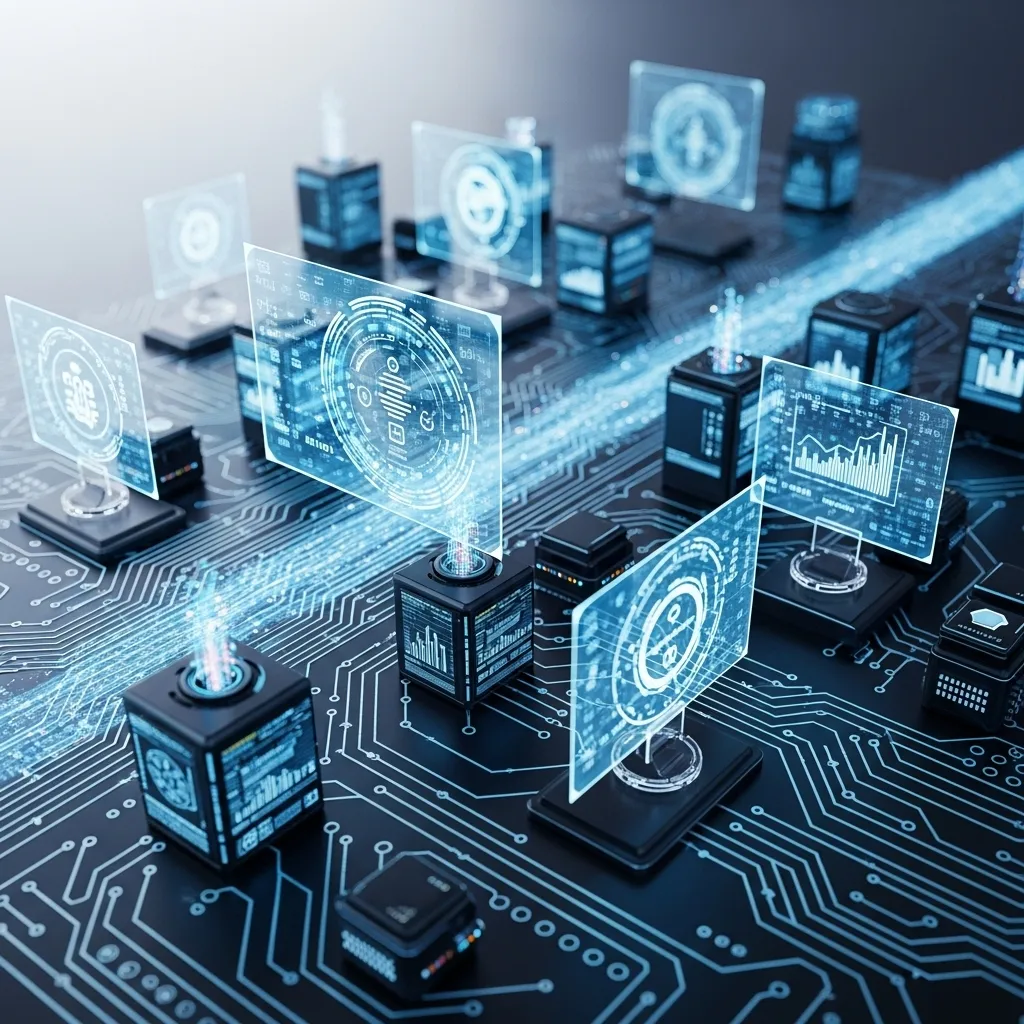
Neural Perception Networks represent a paradigm shift in how artificial intelligence systems process and understand sensory information. These advanced architectures are designed to mimic the hierarchical processing of the human perceptual system, enabling unprecedented levels of understanding and real-time decision-making.
Biological Inspiration
The human brain processes sensory information through a sophisticated hierarchy of neural layers, each extracting increasingly abstract features. Visual cortex neurons, for example, progress from detecting simple edges to recognizing complex objects and scenes. Neural Perception Networks draw inspiration from these biological systems, implementing computational analogs of this hierarchical processing.
Architecture Components
Hierarchical Feature Extraction
Neural Perception Networks employ multiple layers of processing, each responsible for extracting features at different levels of abstraction. Early layers might detect basic patterns like edges, textures, or simple shapes. Middle layers combine these into more complex structures—corners, contours, or primitive objects. Deep layers integrate this information into high-level semantic understanding.
Attention Mechanisms
Modern perception networks incorporate attention mechanisms that allow the system to focus computational resources on relevant aspects of input data. This selective processing mirrors human attention and dramatically improves both efficiency and accuracy. Self-attention mechanisms enable the network to understand relationships between different parts of the input, while cross-attention facilitates integration of information from multiple modalities.
Temporal Processing
Real-world perception is inherently temporal—understanding requires tracking changes over time. Advanced perception networks include recurrent components or temporal convolutions that maintain context across sequences. This enables understanding of motion, prediction of future states, and integration of information across time scales.
Recent Advances
The field of neural perception has seen remarkable progress in recent years:
- Vision Transformers: Applying transformer architectures to visual data has achieved state-of-the-art results on numerous benchmarks
- Neural Architecture Search: Automated methods for discovering optimal network architectures have produced networks that outperform hand-designed solutions
- Few-Shot Learning: Networks can now learn to recognize new categories from just a handful of examples, mimicking human-like learning
- Self-Supervised Learning: Networks trained on unlabeled data using self-supervised objectives can learn rich representations without explicit supervision
- Neural Rendering: Perception networks combined with rendering capabilities enable novel view synthesis and 3D understanding
Performance Optimization
Efficiency Techniques
As networks grow more powerful, efficiency becomes critical for practical deployment. Techniques like network pruning remove unnecessary connections, quantization reduces numerical precision to accelerate computation, and knowledge distillation transfers learning from large teacher networks to smaller student networks suitable for edge deployment.
Hardware Acceleration
Modern perception networks leverage specialized hardware for optimal performance. GPUs provide massive parallelism for matrix operations. TPUs offer even greater efficiency for specific operations common in neural networks. Emerging neuromorphic chips promise to deliver brain-like efficiency by implementing computation closer to biological neural systems.
Applications in the Real World
Neural Perception Networks power countless applications:
Autonomous Navigation: Self-driving vehicles use perception networks to understand complex traffic scenarios, identifying vehicles, pedestrians, traffic signs, and road conditions in real-time.
Medical Imaging: These networks assist radiologists by detecting subtle anomalies in X-rays, MRIs, and CT scans, often identifying issues that might be missed by human observation alone.
Industrial Automation: Manufacturing facilities employ perception networks for quality control, robotic guidance, and predictive maintenance, improving efficiency and reducing defects.
Augmented Reality: AR systems use perception networks to understand 3D environments, enabling realistic placement of virtual objects and natural interaction with digital content.
Research Frontiers
Current research explores several exciting directions. Continual learning enables networks to acquire new capabilities without forgetting previous knowledge. Compositional understanding allows systems to decompose scenes into constituent objects and relationships. Causal reasoning goes beyond correlation to understand cause-and-effect relationships. These advances promise perception systems that approach and potentially exceed human capabilities in specific domains.
At PerceptBase, our research team is actively contributing to these advances. We're developing novel neural architectures that push the boundaries of perceptual understanding while maintaining the efficiency needed for real-world deployment. Our work focuses on creating systems that are not only accurate but also interpretable, reliable, and adaptable to diverse applications.