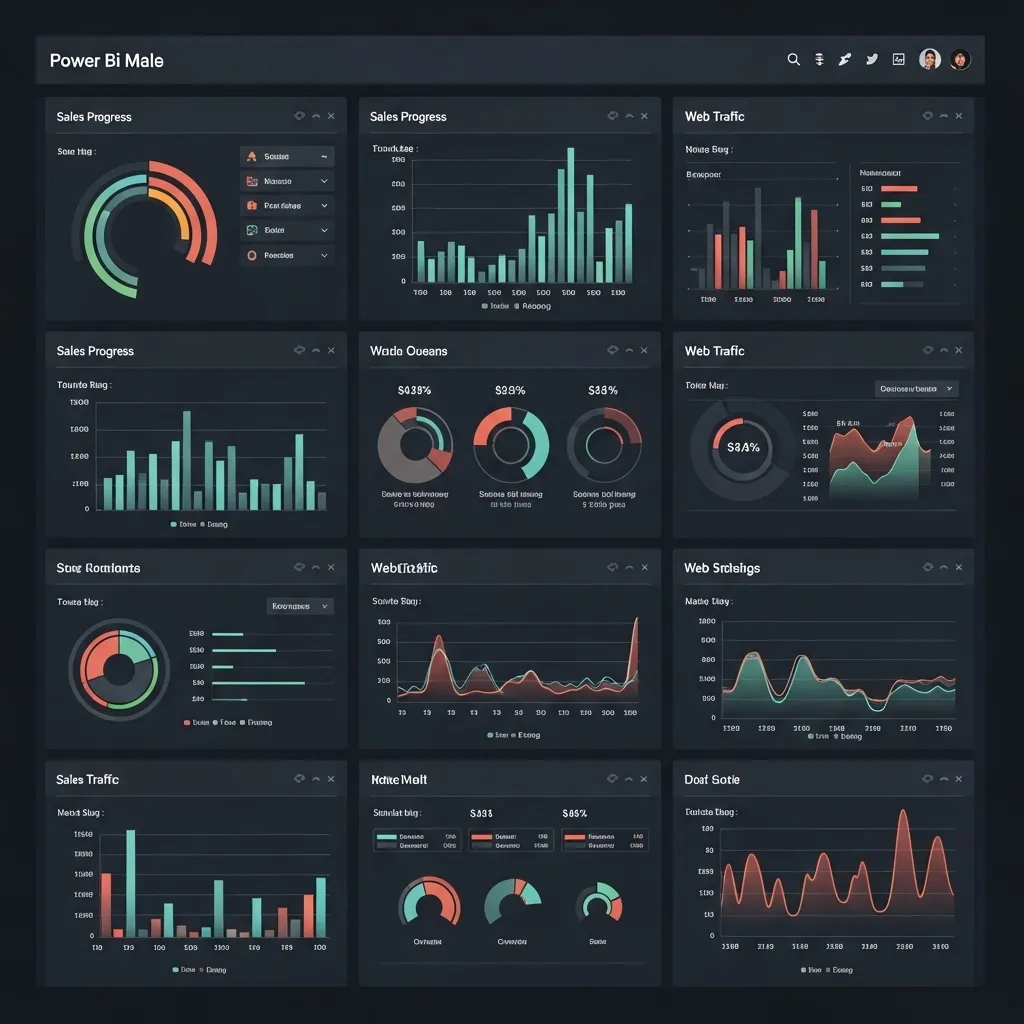
In today's data-driven world, information comes from countless sources in various formats. Multimodal data processing represents the cutting edge of AI technology, enabling systems to synthesize insights from diverse data streams simultaneously.
Understanding Multimodal Processing
Multimodal data processing refers to the ability of AI systems to simultaneously analyze and interpret data from multiple sources or "modalities." These modalities can include text, images, audio, video, sensor data, and more. The true power emerges not from processing each modality independently, but from understanding the relationships and correlations between them.
Key Technologies
Neural Network Architectures
Modern multimodal systems employ sophisticated neural architectures designed to handle heterogeneous data. Transformer-based models have proven particularly effective, allowing attention mechanisms to identify relevant patterns across different modalities. These networks can learn which information sources are most relevant for specific tasks and weight them accordingly.
Feature Extraction and Fusion
Each data modality requires specialized preprocessing and feature extraction techniques. Visual data might use convolutional networks, while text utilizes embedding spaces. The challenge lies in fusing these disparate representations into a unified understanding. Advanced fusion techniques include early fusion (combining raw data), late fusion (combining processed results), and hybrid approaches that balance both strategies.
Real-World Applications
Multimodal processing powers numerous practical applications:
- Content Moderation: Analyzing both images and associated text to identify inappropriate content more accurately than either modality alone
- Medical Diagnosis: Combining patient records, medical imaging, genetic data, and real-time monitoring for comprehensive health assessment
- Customer Service: Understanding customer intent through text, voice tone, and facial expressions in video calls
- Autonomous Vehicles: Integrating camera feeds, LIDAR, radar, and GPS data for safe navigation
- Smart Manufacturing: Monitoring production through visual inspection, acoustic analysis, and sensor readings
Technical Challenges
Despite impressive advances, multimodal processing faces several hurdles. Different modalities often operate at different temporal scales—video at 30 frames per second, audio at thousands of samples per second, and sensor data potentially at even higher frequencies. Synchronizing and aligning these streams requires sophisticated temporal modeling.
Additionally, some modalities may be missing or corrupted in real-world scenarios. Robust multimodal systems must handle such imperfect data gracefully, perhaps relying more heavily on available modalities while accounting for missing information.
The Future Landscape
As computing resources continue to expand and algorithms become more sophisticated, multimodal processing will become increasingly prevalent. We anticipate systems that seamlessly integrate dozens of data sources, providing unprecedented insights and capabilities.
At PerceptBase, we're pioneering advanced multimodal processing solutions that push the boundaries of what's possible. Our systems are designed to handle the complexity of real-world data while maintaining accuracy, speed, and reliability.